Hybridizing existing freight locomotives using a modular battery tender:
Field evaluation of the VOLT platform at MxV Rail
Author: Jacob Dahle, Head of Sustainability and Growth, Dayton-Phoenix Group
Date: March 20, 2026
Preface
Many proposed rail decarbonization solutions require replacing locomotives or electrifying entire networks — approaches that are technically compelling but operationally and economically difficult to deploy at scale. This paper evaluates a different approach: hybridizing existing freight locomotives using a modular battery tender architecture designed to integrate with locomotives already in service.
Abstract
Freight rail remains one of the most energy-efficient modes of transportation, yet the sector faces increasing pressure to reduce greenhouse gas emissions and diesel fuel consumption. Traditional electrification strategies such as overhead catenary infrastructure require significant capital investment and long deployment timelines, while fully battery-electric locomotives often require replacement of existing locomotive fleets and face practical constraints related to cost and operational range.
This paper introduces a modular battery tender architecture, VOLT, designed to enable hybrid electrification of existing diesel-electric locomotives without replacing the locomotive fleet or requiring new fixed infrastructure. The system integrates a high-power battery energy storage platform with the locomotive electrical system, enabling partial substitution of diesel fuel through supplemental electric propulsion support and dynamic braking energy capture.
A field evaluation program conducted at MxV Rail’s test facility in Pueblo, Colorado, assessed the interaction between the battery system and a conventional North American freight locomotive platform under representative operating conditions. Testing focused on hybrid power assistance, system integration, and the ability to capture energy during dynamic braking events.
The results demonstrate the technical feasibility of integrating a battery tender with legacy locomotive platforms while preserving normal locomotive operation. These findings suggest that modular battery systems may provide a practical pathway toward near-term emissions reduction and improved energy efficiency in freight rail fleets without requiring full infrastructure electrification or replacement of existing locomotives.
1. Introduction
Rail operators worldwide are actively evaluating technologies capable of reducing fuel consumption and greenhouse gas emissions from freight locomotives. A wide range of solutions have been proposed, including full network electrification, hydrogen propulsion, and battery-electric locomotives.
Many of these approaches target complete elimination of diesel propulsion. While technically compelling, such solutions often require significant infrastructure investment, full locomotive replacement, or operational changes that are difficult to implement across existing rail networks.
Full electrification through overhead catenary systems requires extensive infrastructure investment, new power distribution systems, and long implementation timelines. Similarly, fully battery-electric locomotives (BELs) represent a promising long-term technology but currently face limitations related to cost, energy density, and operational range for many heavy freight applications. Deployment of BEL fleets also requires substantial capital investment and replacement of existing locomotive assets. Another approach explored in the industry involves “mother-daughter” battery-electric hybrid locomotive configurations, where a modified battery-electric hybrid locomotive operates in conjunction with a powered tender. While this approach can reduce fuel consumption, it typically requires significant modification of the host locomotive and may alter the standalone operating capability of the diesel-electric platform.
The result is that many decarbonization strategies remain long-term concepts rather than near-term deployable solutions.
This paper presents an alternative approach based on incremental electrification of existing locomotive platforms.
The VOLT battery tender system was developed to enable hybrid operation of conventional diesel-electric locomotives by integrating a high-power battery energy storage platform with the locomotive electrical system. The architecture allows the battery system to supplement propulsion power and absorb dynamic braking energy without requiring major modifications to the base locomotive.
It is important to recognize that this approach does not eliminate diesel fuel entirely. Instead, the objective is to achieve meaningful reductions in fuel consumption and emissions using technology that can be deployed quickly and economically across the existing locomotive fleet.
In many cases, a practical solution that can be implemented in the near term may deliver greater cumulative emissions reduction than technologies that require large-scale infrastructure deployment, complete fleet replacement, or waiting for other technologies that capture “real-zero” emissions reductions.
To evaluate the feasibility of this hybrid architecture, Dayton-Phoenix Group conducted a test program at MxV Rail’s facility in Pueblo, Colorado, using a conventional North American freight locomotive platform. The testing focused on system integration, hybrid power support, and the ability to capture energy during dynamic braking events.
The results demonstrate that battery tender systems can integrate with legacy locomotive platforms while preserving operational flexibility, offering a practical pathway toward near-term emissions reduction in freight rail operations.
2. Hybridization opportunity in diesel-electric locomotives
Modern freight locomotives already employ an electrically mediated propulsion architecture in which mechanical power from the diesel engine is converted into electrical energy to drive traction motors.
This architecture presents a natural opportunity for hybridization. Because traction power flows through an electrical system, external energy storage can supplement propulsion or absorb regenerated energy during braking events.
In conventional locomotives, dynamic braking converts locomotive kinetic energy into electrical power which is dissipated as heat through resistor grid assemblies. Integrating energy storage into this architecture creates the potential to recover a portion of that energy for later propulsion use.
Battery tender architectures exploit this opportunity by introducing high-power energy storage into the locomotive consist while preserving the base locomotive configuration.
3. The VOLT battery tender system
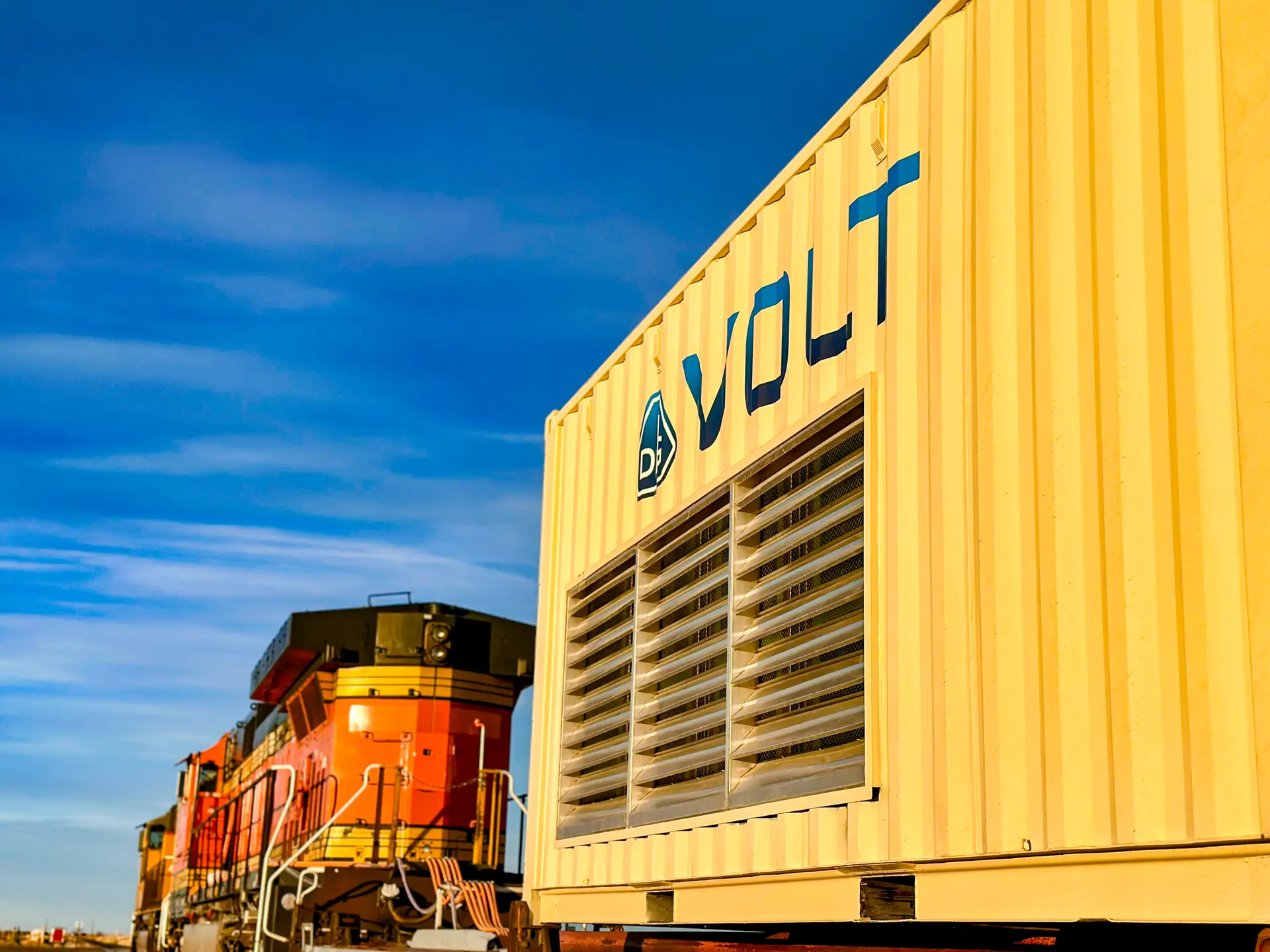
The VOLT platform is a modular battery energy storage system packaged in a tender configuration designed to operate in consist with an existing locomotive.
The system connects to the locomotive’s electrical architecture and provides high-power energy storage capable of both supplying and absorbing electrical energy during operation.
Key system capabilities include:
- Supplemental traction power to reduce diesel load
- Capture of dynamic braking energy
- Load leveling during throttle transitions
- Potential fuel displacement through hybrid operation
Because the battery system is located in a separate tender platform, the architecture avoids major modifications to the locomotive itself. This modular design enables:
- Integration with existing locomotive fleets
- Flexible deployment
- Incremental electrification of rail networks
3.1 System integration philosophy
A key design objective of the VOLT architecture was to minimize integration complexity with existing locomotive platforms.
The battery energy storage system, power electronics, and supervisory control logic are contained entirely within the tender platform, allowing the base locomotive to remain mechanically and operationally unchanged.
This approach avoids the need for modification of the locomotive’s proprietary control systems or internal software. The locomotive continues to operate according to its original design parameters while the battery system responds independently to the locomotive’s operating profile.
Because the hybrid control architecture is located within the tender platform, the locomotive itself does not require reconfiguration or modification to enable operation with the battery system.
Equally important, the operating experience for locomotive engineers remains unchanged. Locomotive throttle positions, braking practices, and general operating procedures remain identical to conventional locomotive operation.
Engineers therefore continue to operate the locomotive according to the same throttle notch and power management practices used in standard diesel-electric operation. No additional operator interaction with the battery system is required.
This design philosophy was intended to ensure that hybrid operation could be implemented without introducing operational complexity, additional training requirements, or disruption to established railroad operating practices.
The hybrid architecture therefore functions as an external energy system operating in parallel with the locomotive rather than as a modification to the locomotive itself.
Because the architecture does not require modification of the locomotive control system, the same battery tender concept can potentially be deployed across multiple locomotive platforms with minimal integration complexity.
3.2 Operational transparency and safety considerations
Another key objective in the design of the VOLT battery tender architecture was to ensure that hybrid operation could be implemented without affecting existing locomotive safety systems or requiring modification of the locomotive’s proprietary control architecture.
The battery system operates as an external energy resource that supplements locomotive propulsion demand without altering the locomotive’s onboard control logic. From the perspective of the locomotive, the hybrid system effectively reduces the power demand placed on the diesel-electric propulsion system during certain operating conditions.
Because the hybrid control architecture resides entirely within the tender platform, the locomotive’s existing safety and control systems continue to function according to their original design.
Operationally, locomotive engineers interact with the locomotive in the same manner as conventional diesel-electric operation. Throttle notch positions, braking practices, and power management procedures remain unchanged. Engineers trained to operate locomotives according to engine RPM targets or throttle notch positions therefore continue to operate the locomotive exactly as they would in standard service.
Hybrid operation is therefore transparent to the locomotive operator, and no additional operator interaction with the battery system is required. In effect, the hybrid system allows the locomotive to achieve the same operational output while requiring less work from the diesel propulsion system.
3.3 Hybrid control strategy
While hybrid operation is operationally transparent to the locomotive operator, the VOLT battery tender system incorporates internal supervisory control logic designed to optimize energy utilization during locomotive operation.
The control system evaluates the locomotive operating state and manages battery power flow accordingly. One important aspect of this strategy is the selective substitution of battery power at different throttle notch levels.
Because diesel engine efficiency varies across operating points, certain throttle positions provide greater opportunities for fuel displacement through hybrid power assistance. The battery system therefore modulates power support in response to locomotive operating conditions to maximize potential fuel savings while maintaining normal locomotive behavior.
All hybrid control functions are implemented within the battery tender platform, allowing optimization of energy usage without requiring modification of the locomotive control system.
4. Test program at MxV Rail
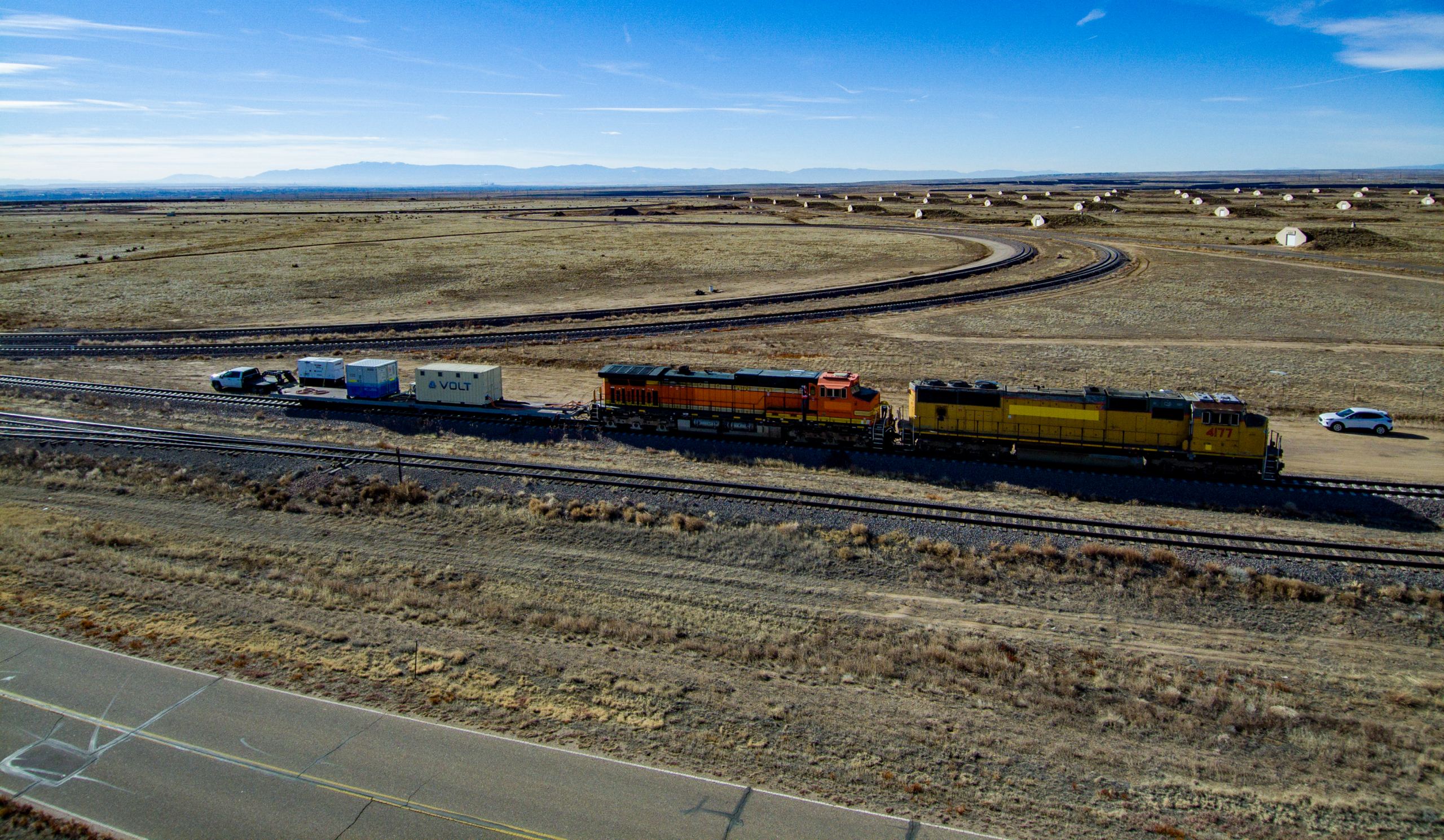
To evaluate the feasibility of integrating a modular battery energy storage system with an existing freight locomotive platform, Dayton-Phoenix Group conducted a controlled test program at MxV Rail’s facility in Pueblo, Colorado.
The MxV Rail facility provides a neutral testing environment widely used by the rail industry to evaluate new technologies under controlled operating conditions. Testing was performed using a conventional North American diesel-electric freight locomotive platform representative of locomotives currently in service.
The purpose of the test program was not to modify or analyze the locomotive’s proprietary control systems, but rather to evaluate the external interaction between a battery energy storage system and the locomotive’s operational power demand profile.
Testing focused on several key areas:
- Ability of the battery system to support locomotive power demand during traction events
- Capability to absorb electrical energy generated during dynamic braking
- Overall operational compatibility between the battery system and locomotive duty cycles
Operational data used during the evaluation was derived from externally observable locomotive behavior and system-level measurements, consistent with standard rail technology validation practices.
The locomotive operated under representative duty cycles including acceleration, sustained power application, and braking events. These scenarios were selected to simulate typical freight service operating conditions.
The objective of the test program was to confirm that a modular battery tender system could operate alongside an existing locomotive platform without disrupting baseline locomotive functionality.
The testing described in this paper focused exclusively on the evaluation of the battery energy storage system and its interaction with locomotive operating conditions. No modifications were made to the locomotive’s proprietary control systems.
5. Hybrid operation strategy
Hybrid operation using a battery tender focuses on energy substitution rather than full electrification.
Instead of replacing the diesel engine entirely, the battery system supplements locomotive power when beneficial.
This strategy offers several advantages:
- Reduced fuel consumption during high power demand
- Improved efficiency during throttle transitions
- Capture and reuse of braking energy
- Reduced engine load during peak operations
The hybrid architecture maintains full diesel functionality while allowing electric energy to assist propulsion when available.
This enables the locomotive to operate seamlessly across networks that do not have electrified infrastructure.
6. Dynamic braking energy recovery
One of the most promising opportunities for energy recovery in freight rail operations is dynamic braking.
During downhill operation or deceleration, traction motors act as generators. In traditional locomotives, the generated electrical energy is dissipated through resistor grids.
By integrating battery storage into the locomotive electrical system, it becomes possible to capture a portion of this energy and store it for later use.
During testing, dynamic braking events demonstrated the potential for the battery system to absorb significant electrical power generated during braking cycles.
Capturing this energy provides two benefits:
- Improved overall energy efficiency
- Increased availability of stored energy for propulsion support
This capability represents a key mechanism for improving the efficiency of freight locomotive operations.
7. Results and operational observations
Testing at the MxV Rail facility demonstrated that the battery tender architecture can operate alongside a conventional freight locomotive platform while maintaining normal locomotive operation.
Several key operational behaviors were observed during the evaluation:
- Hybrid power support
The battery system demonstrated the ability to supply supplemental electrical power during traction events, reducing reliance on diesel engine output during periods of elevated power demand. Because the system operates in parallel with the locomotive’s existing propulsion architecture, hybrid assistance can occur without requiring changes to the locomotive’s operating practices. This capability supports the potential for partial displacement of diesel fuel during certain operating conditions.
- Dynamic braking energy capture
Dynamic braking events generated significant electrical energy as traction motors operated in generator mode. In conventional locomotives, this energy is dissipated through resistor grids as heat. The battery energy storage system demonstrated the ability to absorb a portion of this electrical energy during braking events. This capability enables the recovery of energy that would otherwise be lost and makes it available for later propulsion support. Energy recovery during dynamic braking represents one of the most promising mechanisms for improving the overall energy efficiency of diesel-electric locomotives.
- Operational compatibility
A key objective of the evaluation was to confirm that the hybrid system could operate without disrupting normal locomotive operation. Testing confirmed that locomotive operation remained consistent with conventional operating practices. Engineers continued to operate the locomotive using standard throttle notch positions and braking procedures. Because the hybrid control architecture resides entirely within the battery tender platform, no modification of the locomotive control system was required. From the operator’s perspective, locomotive behavior remained unchanged.
- Integration simplicity
The modular architecture of the battery tender allowed the hybrid system to function as an external energy resource rather than as a modification to the locomotive itself. This design philosophy reduces integration complexity and minimizes potential impacts on existing locomotive fleets. Maintaining the locomotive’s original configuration while adding hybrid capability represents a key advantage of the battery tender approach.
8. Economic implications for fleet decarbonization
Freight rail decarbonization strategies frequently focus on long-term solutions such as full network electrification or the replacement of diesel locomotives with fully battery-electric platforms. While these approaches may ultimately play an important role in the evolution of rail transportation, they often require large infrastructure investments, extended deployment timelines, and significant changes to fleet operations.
The VOLT battery tender architecture explores a different pathway: enabling hybrid electrification of the existing locomotive fleet.
Because VOLT operates as an external energy platform contained within a tender car, the system supplements locomotive propulsion without requiring modification of the locomotive’s onboard control system or safety architecture. The locomotive therefore continues to operate according to its original design parameters while the battery system autonomously manages energy substitution and recovery.
This approach allows rail operators to introduce hybrid capability into existing fleets with minimal disruption to operations, while capturing some of the efficiency benefits associated with electrified propulsion.
In this context, the VOLT architecture represents a form of incremental electrification, enabling meaningful reductions in diesel consumption while preserving the operational flexibility of diesel-electric locomotives.
9. Path toward deployment
The results of the evaluation suggest that modular battery tender systems such as VOLT can be integrated with conventional freight locomotive platforms while preserving normal operating practices.
Because the hybrid control architecture is located entirely within the tender platform, deployment does not require modification of locomotive control systems or retraining of locomotive operators. Engineers continue to operate the locomotive according to standard throttle notch positions and established operating procedures.
This integration philosophy allows hybrid capability to be introduced in a manner that minimizes operational risk while leveraging the large installed base of diesel-electric locomotives already in service.
Future development of the VOLT platform will include expanded field trials, optimization of hybrid control strategies, and evaluation across additional locomotive platforms and freight duty cycles.
Such efforts will help further quantify the operational and economic benefits of hybrid battery assistance in freight rail service.
10. Conclusion
Freight rail faces increasing pressure to reduce emissions while maintaining reliable and cost-effective transportation services.
While many proposed solutions focus on complete elimination of diesel propulsion, these approaches often require large infrastructure investments or full replacement of existing locomotive fleets. As a result, many decarbonization strategies remain difficult to deploy at scale in the near term.
The VOLT battery tender system represents an alternative approach focused on hybridizing the locomotives already in service.
Testing conducted at MxV Rail demonstrated that a modular battery energy storage platform can operate alongside a conventional freight locomotive while maintaining normal locomotive operation. The architecture allows supplemental propulsion power and capture of dynamic braking energy while preserving the locomotive’s existing control systems and safety architecture.
Perhaps most importantly, hybrid operation using VOLT does not alter how the locomotive is operated. Engineers continue to operate the locomotive according to established throttle notch and engine RPM practices, while the battery system autonomously manages energy substitution and recovery within the tender platform.
Modular battery tender architectures, like VOLT, therefore offer a practical pathway toward near-term electrification of freight rail fleets while preserving the operational flexibility and infrastructure independence that have long defined diesel-electric locomotive operation.
Rather than replacing locomotives, the VOLT platform focuses on electrifying the locomotives already in service.